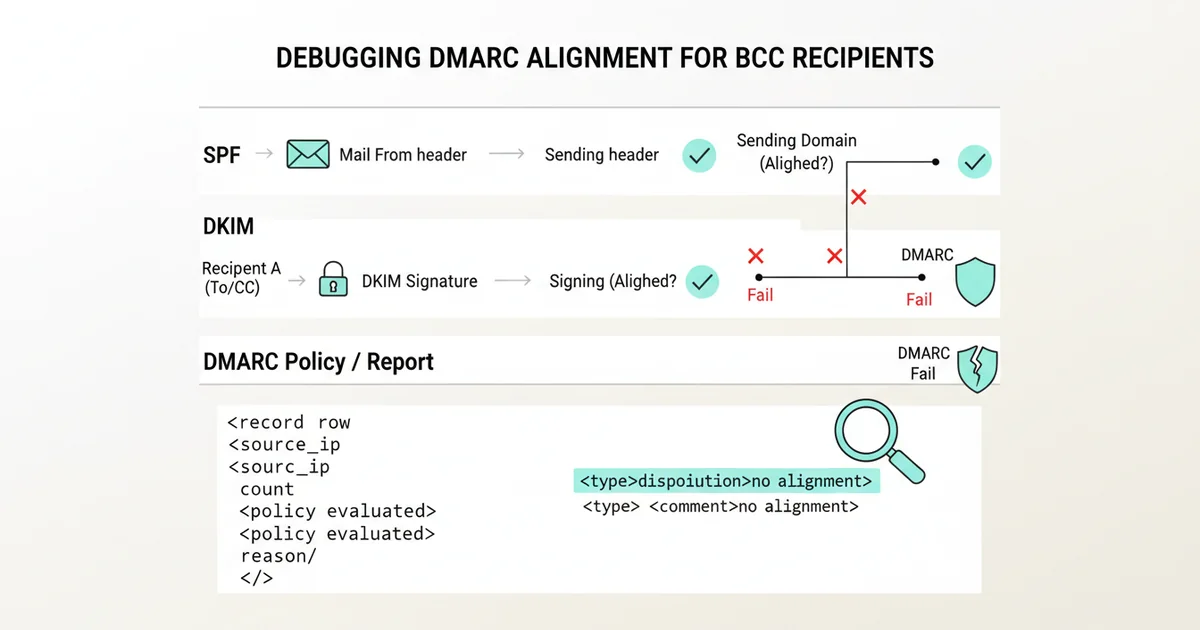
Debugging DMARC Reports Showing Alignment Failures for BCC Recipients
DMARC is a critical layer in email security, designed to protect your domain from impersonation and phishing. It relies on SPF and DKIM, but crucially, adds an "alignment" requirement: the domains used for SPF and DKIM must align with your Header-From domain. When DMARC fails, it's often due to misconfigurations in your own sending infrastructure or third-party services. However, a particularly insidious class of DMARC failures can occur with BCC recipients, often without your direct knowledge or control.
This article dives into why BCC recipients frequently trigger DMARC alignment failures in your aggregate reports, how to diagnose them, and what practical steps you can take to mitigate these issues.
A Quick Refresher on DMARC Alignment
Before we tackle the specifics of BCC, let's quickly re-anchor on DMARC alignment. DMARC requires that either SPF or DKIM (or both) pass and be aligned with the Header-From domain.
- SPF Alignment: For SPF to be aligned, the domain in the
Return-Path(also known asMailFromorEnvelope-From) header must either exactly match or be a subdomain of theHeader-Fromdomain. If yourHeader-Fromisyourdomain.comand theReturn-Pathisbounce.thirdparty.com, SPF might pass (ifbounce.thirdparty.comis correctly configured), but it will fail alignment withyourdomain.com. - DKIM Alignment: For DKIM to be aligned, the domain specified in the
d=tag of the DKIM signature must either exactly match or be a subdomain of theHeader-Fromdomain. If yourHeader-Fromisyourdomain.comand a DKIM signature hasd=thirdparty.com, DKIM might pass (ifthirdparty.comis correctly configured), but it will fail alignment withyourdomain.com.
For DMARC to pass, at least one of these (SPF or DKIM) must pass and be aligned.
Why BCC Recipients Are a Special Case for DMARC Alignment
The core issue with BCC recipients stems from the nature of the BCC header itself. The "Blind Carbon Copy" header is stripped from the email before it reaches the BCC recipient's mail server. This means the BCC recipient receives what appears to be a direct message, without any indication that other recipients were included.
However, the path an email takes to a BCC recipient can often be more complex than a direct TO/CC delivery. Here's why BCC often leads to alignment failures:
- Mail Forwarding: